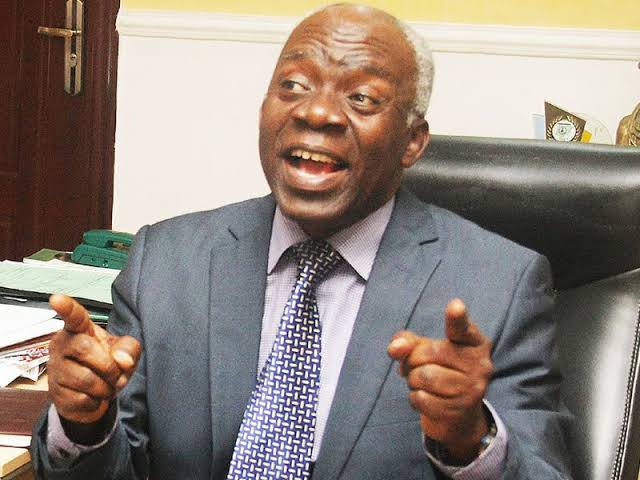
Femi Falana, a well-known human rights lawyer and senior advocate, has disclosed the reasons behind former President Umaru Yar’Adua’s decision to cancel the sale of the Port Harcourt refinery to a consortium led by Dangote Oil. Falana characterized this cancellation as an essential measure to rectify the legal and ethical issues related to the sale and safeguard Nigeria’s national interests.
In an extensive statement, Falana noted that, according to the Privatisation and Commercialisation Act, the Vice President serves as the chairman of the National Council on Privatisation (NCP), which oversees the privatization of public enterprises. However, he claimed that former President Olusegun Obasanjo violated this legal framework by ignoring then-Vice President Atiku Abubakar and directly handling the privatization of numerous state assets.
He highlighted that on May 17, 2007, President Obasanjo sold a 51% interest in the Port Harcourt refinery to Bluestar Oil for $561 million, and a similar transaction followed on May 28, 2007, with the sale of 51% of the Kaduna Refinery for $160 million.
The consortium Bluestar Oil, which included Dangote Oil, Zenon Oil, and Transcorp, quickly faced scrutiny over these deals, as critics pointed out possible conflicts of interest due to Obasanjo’s substantial shareholding in Transcorp. The sales were conducted just before the end of Obasanjo’s term and were seen as hasty and lacking in transparency.
Falana pointed out that these transactions were met with significant opposition from major stakeholders such as the National Union of Petroleum and Natural Gas Workers (NUPENG) and the Petroleum and Natural Gas Senior Staff Association of Nigeria (PENGASSAN), who raised alarms about due process and suggested that Nigeria was shortchanged.
He quoted the unions as alleging that the $516 million paid for the Port Harcourt refinery shares actually represented a value of $5 billion. Firm in their belief that the deals were against the national interest, both unions initiated a four-day strike in June 2007, which nearly halted the Nigerian economy.
The unions called off their strike after the federal government pledged a comprehensive investigation into the deals. Following this inquiry, President Yar’Adua nullified the privatizations of both the Port Harcourt and Kaduna refineries.
Falana emphasized that the cancellation of the privatization was not legally contested as it contradicted the principles of the Privatisation and Commercialisation Act. He applauded NUPENG and PENGASSAN for their commitment to national interests and urged them to stay alert in light of renewed discussions about privatizing Nigeria’s refineries.
Falana called on these unions to escalate their long-standing advocacy as a counterbalance to the renewed push for privatization of the refineries, suggesting that those eager for privatization should consider establishing their own facilities similar to the Dangote Group.
His remarks illustrate the persistent debate surrounding privatization in Nigeria, with organizations like ASCAB stressing the urgent need for transparency and adherence to proper procedures in the management of public resources.
