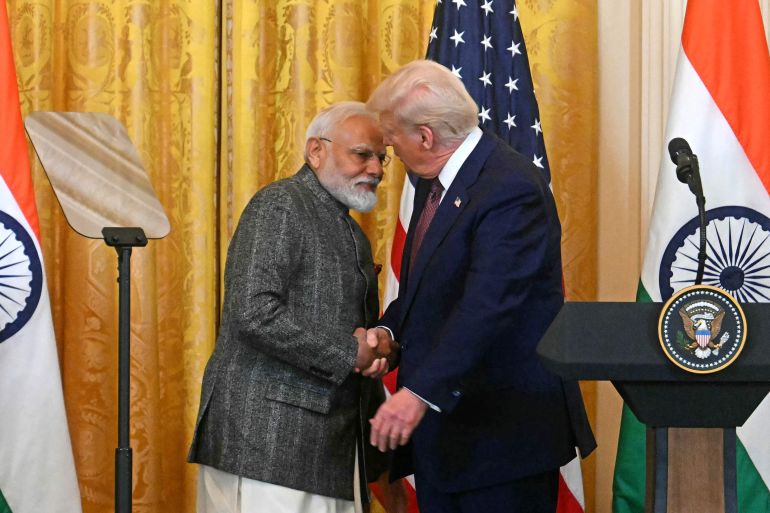
Indian exporters have raised serious concerns over their business viability following President Donald Trump’s decision to impose increased tariffs on Indian goods in retaliation for New Delhi’s ongoing purchases of discounted Russian oil.
Markets reacted modestly on Thursday, with the Nifty index slipping 0.31 percent after an initial 25 percent U.S. tariff kicked in. However, the situation is set to worsen, as Trump signed an executive order on Wednesday to double the tariff to 50 percent within three weeks, citing India’s continued support of Russia through oil purchases—a major funding source for Moscow’s war in Ukraine.
India, the second-largest buyer of Russian oil, has benefited significantly from low-cost crude. But the latest move has drawn sharp criticism from India’s foreign ministry, which slammed the tariff escalation as “unfair, unjustified, and unreasonable.”
S.C. Ralhan, president of the Federation of Indian Export Organisations (FIEO), warned that the decision would have a devastating effect on exporters. “Nearly 55 percent of our shipments to the U.S. are now directly impacted,” he stated, adding that the added tariffs could create a 30–35 percent competitive disadvantage for Indian exporters compared to rivals in countries facing lower trade barriers.
Ralhan revealed that many export orders have already been paused as U.S. buyers reconsider sourcing plans, particularly affecting small and medium-sized businesses already operating on thin profit margins. “Absorbing this sudden cost increase is simply not viable,” he said.
India, which shipped $87.4 billion worth of goods to the U.S. in 2024, relies heavily on American demand, with U.S. consumption contributing around 2.5 percent to India’s GDP.
According to Shilan Shah of Capital Economics, the steep 50 percent tariff could significantly dampen India’s growth prospects. “This level of tariff could reduce economic growth to around six percent in 2025, down from the earlier seven percent forecast,” Shah noted, cautioning that India’s emergence as a global manufacturing hub could be seriously undermined if the tariffs remain.
