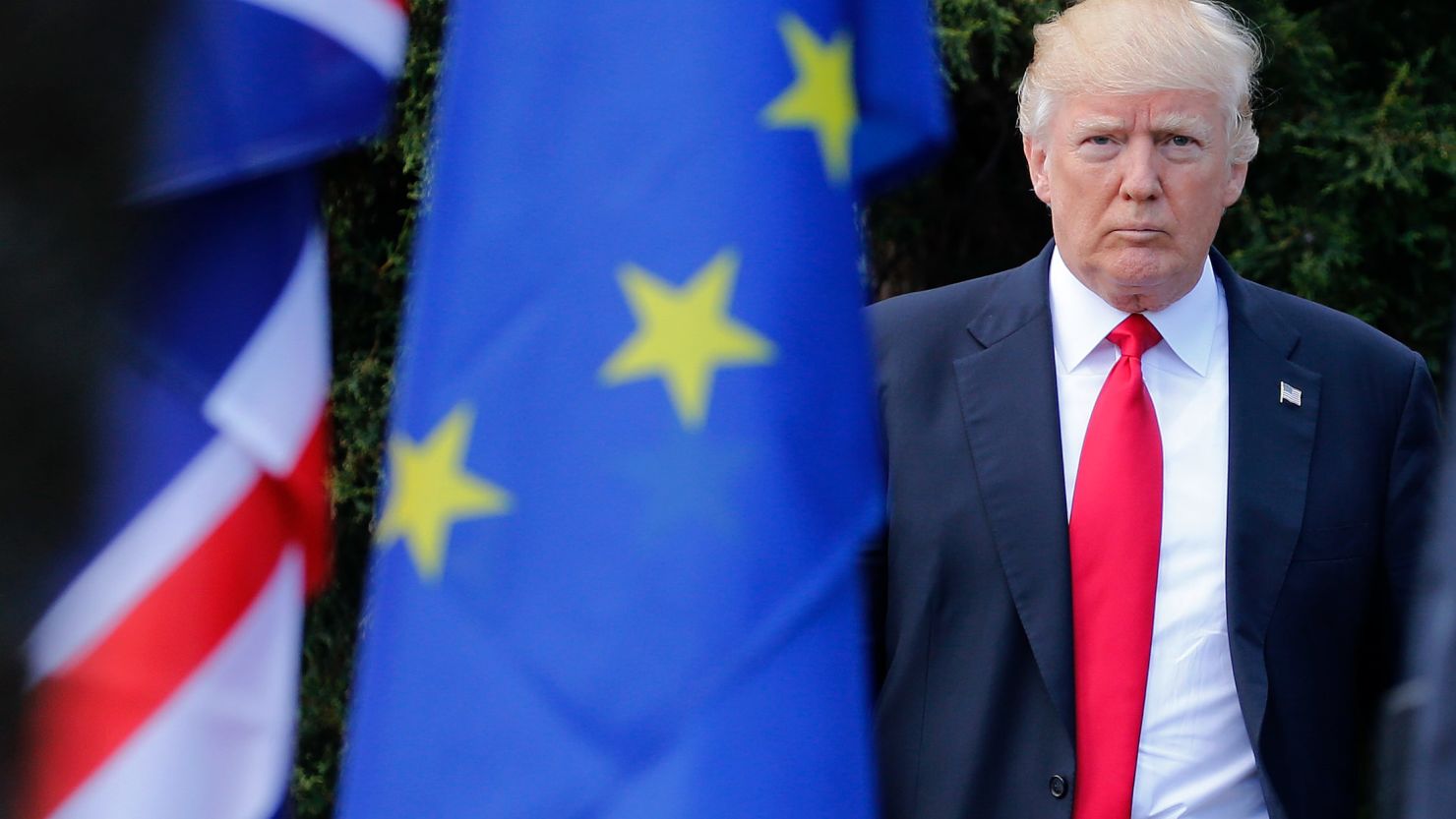
European leaders have rejected a request by U.S. President Donald Trump for allied military support to secure the Strait of Hormuz, as European Union foreign ministers met in Brussels to discuss the surge in global oil prices triggered by the ongoing U.S.–Israeli war on Iran.
The pushback followed Trump’s call for countries including the United Kingdom, China, France, Japan, South Korea and other NATO partners to deploy naval forces to protect the critical oil shipping route.
Trump warned that failure by allies to support the operation could have serious implications for the future of NATO.
U.S. officials spent the weekend lobbying partners to back the proposal and expressed hope that a coalition to secure the strategic waterway could be announced in the coming days, according to sources familiar with the discussions.
However, several American allies signaled caution about deploying military assets to the contested waterway while the war remains active.
At the Brussels meeting, EU foreign ministers demanded greater clarity on Washington’s war strategy and timeline before considering any support for the mission.
Germany’s Foreign Minister, Johann Wadephul, said Berlin had no plans to join military operations related to the conflict, stressing that NATO members needed clearer information on the objectives and duration of the campaign.
“We expect the United States and Israel to inform us and include us in what they are doing there, and to tell us when these goals have been achieved,” Wadephul said.
He added that discussions should eventually move toward establishing a broader regional security framework involving neighbouring states once the situation becomes clearer.
Germany’s position was reinforced by government officials in Berlin. Chancellor Friedrich Merz’s spokesperson, Stefan Kornelius, said the conflict was not NATO’s responsibility.
“The United States did not consult us before this war, so we do not believe it is a matter for NATO or the German government,” Kornelius said.
German Defence Minister Boris Pistorius also questioned the proposal, asking what a small number of European frigates could achieve in the strait that the powerful U.S. Navy could not.
“This is not our war. We did not start it,” Pistorius said.
Other European countries also signaled reluctance.
Greek government spokesman Pavlos Marinakis said Athens would not participate in military operations in the Strait of Hormuz, while Italian Foreign Minister Antonio Tajani confirmed that Italy was not involved in naval missions that could be expanded to the region.
Estonian Foreign Minister Margus Tsahkna said European allies wanted to understand Washington’s strategic objectives before making commitments.
Similarly, Polish Foreign Minister Radek Sikorski said any request should come through NATO’s formal channels before it could be considered.
“If there is a request via NATO, we will of course consider it very carefully out of respect for our American allies,” he said.
However, Denmark’s Foreign Minister Lars Lokke Rasmussen urged Europe to remain open-minded about helping ensure freedom of navigation through the vital shipping route.
“We must face the world as it is, not as we want it to be,” Rasmussen said, stressing the need for a plan that prioritizes de-escalation.
The United Kingdom said it was working with partners on a collective plan to reopen the Strait of Hormuz and restore freedom of navigation in the region.
Prime Minister Keir Starmer said Britain would avoid being drawn into a wider conflict but would continue discussions with allies on stabilizing the situation.
EU foreign policy chief Kaja Kallas said the bloc would examine how member states could contribute to reopening the strategic waterway.
The closure of the strait has pushed global oil prices above $100 per barrel and raised concerns about global supply disruptions.
Kallas warned that the disruption was indirectly benefiting Russia by boosting energy revenues that help fund its war in Ukraine.
IEA Ready to Release More Oil Reserves
Meanwhile, the International Energy Agency (IEA) said it stands ready to release additional oil reserves if the supply disruption worsens.
The agency last week released a record 400 million barrels of oil to cushion the impact of the blockade.
IEA Executive Director Fatih Birol described the situation as the largest supply disruption in the history of the global oil market, surpassing even the 1973 oil crisis.
While oil prices have eased slightly in recent days, Birol said emergency reserves could only provide temporary relief if shipping through the Strait of Hormuz remains blocked.
The IEA still holds more than 1.4 billion barrels in strategic reserves, giving it room to intervene further if necessary.
