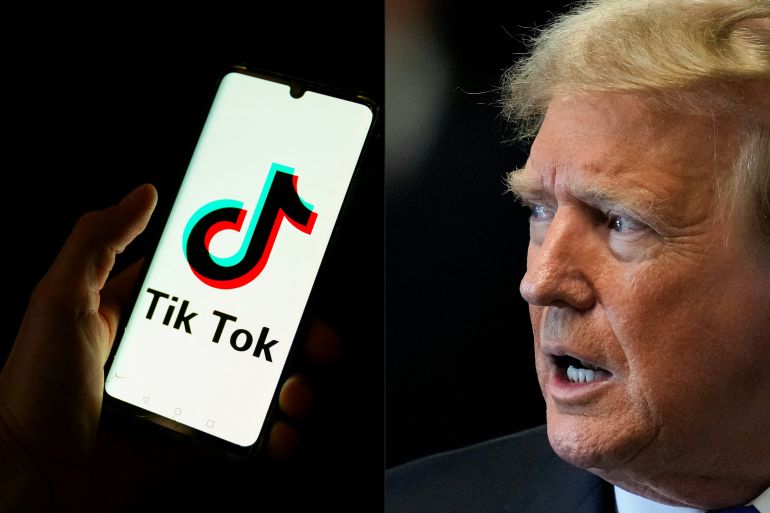
President-elect Donald Trump expressed his intention on Sunday for the United States to acquire partial ownership of TikTok and announced plans to issue an executive order that would postpone a ban on the app to facilitate negotiations. This announcement followed TikTok becoming inaccessible in the U.S. due to legislation citing national security concerns, which prompted a deadline for its Chinese parent company, ByteDance, to divest its U.S. operations.
The law provides a 90-day extension if the administration can demonstrate progress toward a workable agreement, but ByteDance has consistently refused to sell. Outgoing President Joe Biden’s administration decided to leave the decision regarding TikTok to Trump, who will assume office on Monday, indicating that they would not enforce the ban.
Trump stated on his Truth Social platform, “I will issue an executive order on Monday to extend the period of time before the law’s prohibitions take effect, so that we can make a deal to protect our national security.” He suggested that the U.S. should hold a 50% interest in a joint venture, claiming the app’s value could rise to potentially “hundreds of billions or maybe trillions of dollars.” He emphasized that this approach would ensure TikTok remains in responsible hands.
TikTok has gained popularity for showcasing diverse content from users, transforming them into global sensations, but it has also faced criticism for misinformation and national security risks due to its Chinese ownership. The company mentioned in a message to users that they were hopeful for a resolution with Trump after he takes office.
Despite having previously supported a ban on TikTok, Trump did not elaborate on the proposed deal. The app’s shutdown coincided with a recent Supreme Court decision upholding the ban pending a sale. Trump’s newfound support for TikTok has stemmed from its ability to engage younger voters.
Experts have expressed skepticism about how the new president can lift the ban without ByteDance selling. The legislation effectively restricts the president’s power over the situation.
The law not only prohibits TikTok’s availability in app stores but also requires tech companies like Apple and Google to block downloads, imposing heavy fines for violations. Oracle, which manages TikTok’s servers, is also compelled to enforce the ban. Public reactions on social media ranged from discontent to dark humor, recalling Trump’s past efforts to ban the app.
In Europe, a government official in Estonia suggested that similar restrictions should be considered within the region. The ban even became a talking point during the Australian Open, where tennis player Coco Gauff expressed her fondness for TikTok and hope for its return.
Additionally, a last-minute merger proposal from the startup Perplexity AI for TikTok’s U.S. operations surfaced, although the potential cost was estimated to be at least $50 billion. Frank McCourt, former owner of the Los Angeles Dodgers, also expressed interest in acquiring TikTok’s U.S. business. As the ban loomed, many TikTok users turned to Xiaohongshu, a Chinese social media app similar to Instagram, which recently topped the app download charts in the U.S.
