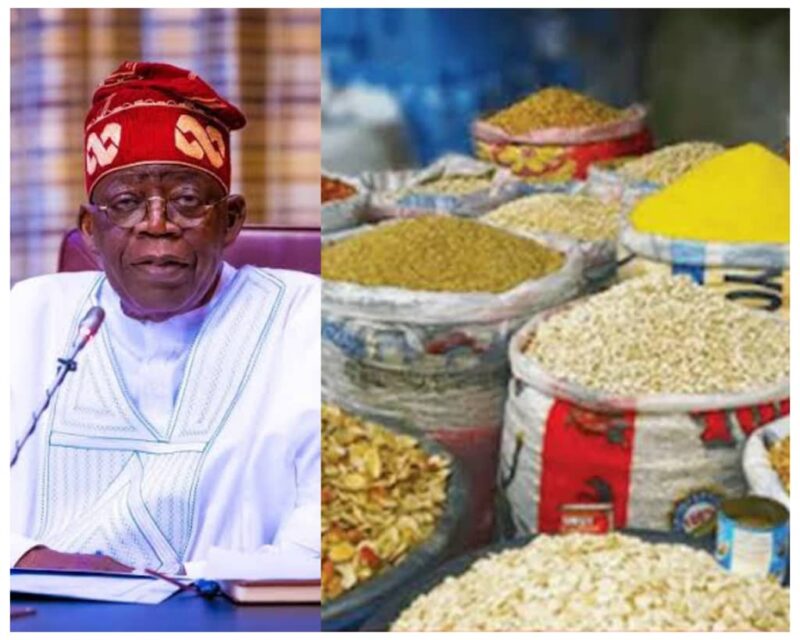
The administration of President Bola Tinubu is facing increasing pressure to abandon the food import waiver that was announced in July 2024. Various sources within the Presidency have indicated that this pressure primarily comes from the private sector, which argues that allowing food imports could jeopardize their investments and heighten unemployment in Nigeria.
Private sector representatives have echoed these concerns, labeling the food import waiver as a double-edged sword. While it may lower the prices of imported goods, it could also significantly harm local production.
A source within the presidency, speaking anonymously due to lack of authorization, stated that media reports have highlighted the government’s struggle to implement the import waiver. According to this source, the government’s hesitance is largely motivated by the need to protect local businesses. Industry groups like the Manufacturers Association of Nigeria (MAN) and the Lagos Chamber of Commerce and Industry (LCCI) have urged the government to avoid food imports, advocating instead for a focus on boosting local production.
Another source pointed out that members of the Organized Private Sector have stressed that increased importation would harm local companies and jobs.
On July 10, 2024, the Minister of Agriculture and Food Security, Abubakar Kyari, announced a 150-day suspension of duties, tariffs, and taxes on the importation of maize, brown rice, wheat, and cowpeas through Nigeria’s borders, as part of a broader effort to combat food inflation.
Kyari explained that the government’s actions aimed to address food inflation driven by availability and affordability issues, outlining that this import window would involve a Recommended Retail Price for the imported commodities.
The minister also mentioned that the government planned to import 250,000 metric tons each of wheat and maize, targeting small-scale processors and millers in the country.
However, since this announcement, there has been no clarification from the government or the Nigeria Customs Service regarding how this waiver would be implemented. In a report from the third quarter of 2024, Customs indicated that the Treasury could miss out on N188.37 billion in revenue over the subsequent six months due to the waiver. Furthermore, companies wishing to benefit from the waiver were required to be incorporated in Nigeria for at least five years.
The initiative, however, failed to materialize, intensifying the hunger crisis in the country.
Segun Kuti-George, the National Vice President of the Nigerian Association of Small-Scale Industrialists, expressed concern that the food import waiver is a double-edged sword. He suggested that while reducing food prices might help ease hunger, it could also hurt local producers, who may struggle to compete with cheaper imports.
He emphasized the need to weigh the benefits against the drawbacks, noting the waiver as a temporary solution rather than a long-term fix. He urged the government to focus on boosting agricultural output while utilizing the waiver period.
Kuti-George criticized the government for failing to implement the promised waiver, arguing that it could have significantly lowered food prices and helped local producers increase their profit margins.
Dr. Muda Yusuf, Director of the Centre for Promotion of Private Enterprise, acknowledged concerns from some in the private sector that the waiver might negatively affect local farmers. However, he attributed the lack of implementation to bureaucratic inefficiencies rather than private sector resistance.
Yusuf reiterated that the waiver was intended as a temporary measure to address food scarcity during a critical time.
Dr. Femi Egbesola, President of the Association of Small Business Owners of Nigeria, lamented the lack of action on such an important government announcement, attributing the failure to lack of coordination among governmental agencies.
Economist Marcel Okeke warned about the risks of introducing the waiver within a corrupt system, stating that it could damage local producers. He expressed skepticism regarding proper implementation and voiced concerns over potential quality issues of imported goods.
As pressure builds, Finance Minister Wale Edun stated that the government is exploring solutions to ensure that the waiver does not undermine local food production. However, efforts to obtain further comments from the finance ministry were unsuccessful.
