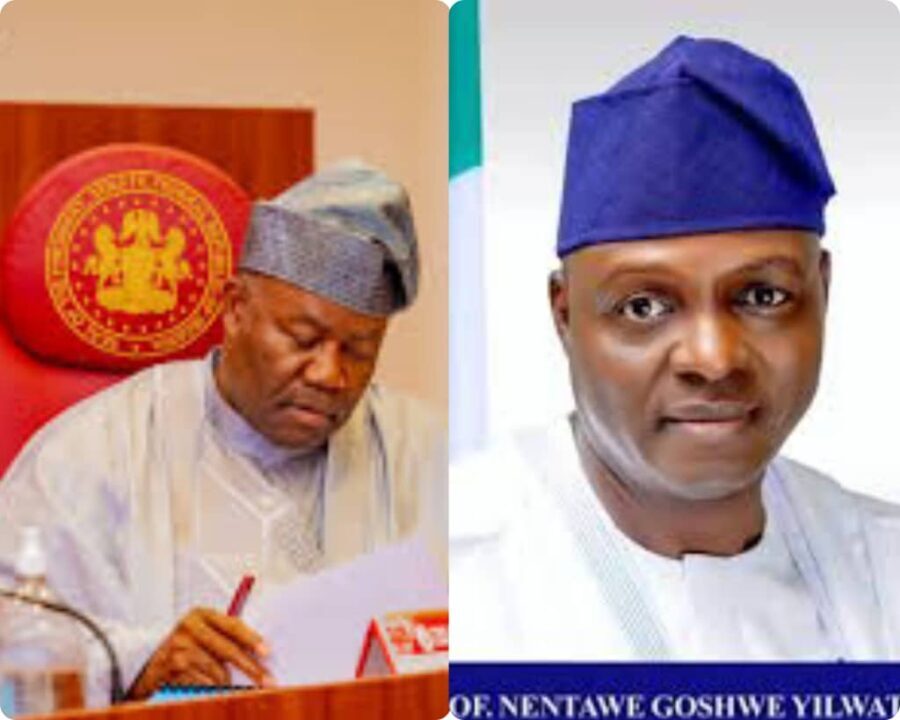
As Nigerians continue to grapple with the rising cost of living, Senate President Godswill Akpabio and the National Chairman of the All Progressives Congress (APC), Prof. Nentawe Yilwatda, have urged citizens to demand accountability from state governors and local government chairmen over the effective use of increased revenue allocations.
Speaking separately at different events in Abuja on Monday, both leaders emphasized the need for sub-national governments to translate the surge in federal allocations into tangible development, improved living standards, and job creation.
At the public presentation of “Vicious Red Circle”, a book on human trafficking by Alex Oriaku, Prof. Yilwatda noted that Nigeria’s governors now receive up to four times more revenue than they did two years ago, following a rise in federal disbursements from ₦400 billion to ₦2.2 trillion monthly. “No governor in Nigeria collects less than three times what they used to receive before. This is the time for citizens to talk to their governors and local government chairmen and demand more people-oriented projects,” he said. Yilwatda, who recently assumed leadership of the APC, maintained that President Bola Tinubu’s administration is steering the economy on the path of recovery, stressing that the party remains focused on restoring economic stability and growth.
On his part, Akpabio, speaking at the joint graduation ceremony of the National Institute for Legislative and Democratic Studies (NILDS) and the University of Benin, tasked State Houses of Assembly to intensify oversight of governors to ensure proper deployment of increased allocations. “Our efforts in the National Assembly have boosted revenue inflows to the Consolidated Revenue Fund, which in turn has increased allocations to the states and federal government.
I call on state legislatures to ensure that these funds translate into improved livelihoods and job creation for citizens,” Akpabio said.
Similarly, the Speaker of the House of Representatives, Rt. Hon. Tajudeen Abbas, reaffirmed the legislature’s commitment to reforming Nigeria’s budget process for greater fiscal discipline. He noted that President Tinubu’s economic reforms are already yielding results, with inflation dropping below 20 percent and the naira showing signs of recovery. “Though it’s not yet uhuru, our economy is on a better growth trajectory. The 10th House of Representatives is committed to ensuring timely and accountable budget processes,” Abbas stated.
The Director-General of NILDS, Prof. Abubakar Sulaiman, also called for increased investment in tertiary education in the 2026 budget, warning that low funding undermines human capital development and contributes to poor-quality graduates.
Meanwhile, at the book presentation, discussions shifted to the growing menace of human trafficking. The Director-General of the National Intelligence Agency (NIA), Mohammed Mohammed, described it as a “dangerous transnational crime,” comparable to drug and arms trafficking, while pledging continued NIA support to the National Agency for the Prohibition of Trafficking in Persons (NAPTIP). Reviewer of the 198-page book, Dr. Ike Neliaku, President of the Nigerian of Public Relations, highlighted the connection between corruption, manipulation, and exploitation, urging Nigerians to reject the “culture of silence” that enables human trafficking.
Author Alex Oriaku said “Vicious Red Circle” exposes the cycle of exploitation and silence that fuels trafficking.
“It’s a vicious circle that preys on the desperate, the vulnerable, and the unseen,” he said.
