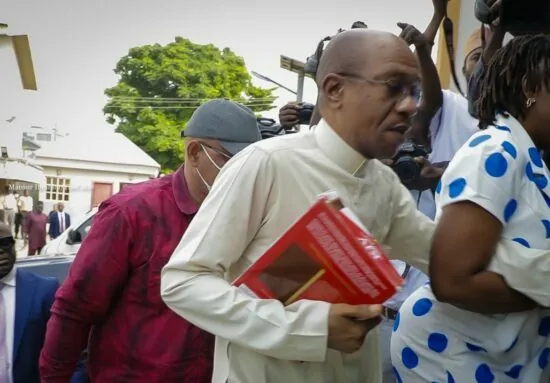
The Lagos Division of the Court of Appeal has reversed the final forfeiture order placed on the assets of former Central Bank of Nigeria Governor Godwin Emefiele, which had been awarded to the Federal Government.
In a split ruling of two-to-one, issued on April 9, 2025, and revealed in a certified true copy obtained by our correspondent on Sunday, the appellate court annulled the earlier judgment and directed a retrial in the lower court.
Previously, the Federal High Court in Lagos had, on November 1, 2024, accepted the Economic and Financial Crimes Commission’s (EFCC) request for the final forfeiture of Emefiele’s assets.
The confiscated properties included two separate duplexes on Hakeem Odumosu Street in Lekki Phase 1, Lagos; an undeveloped plot of land in Ikoyi; a bungalow on Oyinkan Abayomi Drive, Ikoyi; and a four-bedroom duplex on Probyn Road, Ikoyi.
Additional properties included an industrial complex being built on 22 parcels of land in Agbor, Delta State; eight incomplete apartments on a plot at Adekunle Lawal Road in Ikoyi; and a detached duplex on Bank Road in Ikoyi.
Moreover, the court also ordered the forfeiture of $2,045,000 and shares from Queensdorf Global Fund Limited to the Federal Government.
The EFCC contended that these properties were likely obtained through illegal activities.
Dissatisfied with the lower court’s ruling, Emefiele, represented by his legal team led by Olalekan Ojo (SAN), appealed the decision.
The EFCC was identified as the sole respondent in the appeal case CA/LAG/CV/1051/24.
The appellant raised five points for consideration, questioning whether the trial judge sufficiently assessed the evidence presented before approving the EFCC’s motion for forfeiture, whether the judge erred in not recognizing Emefiele’s interest in the properties, if it was correct to reject Emefiele’s motion for a stay of proceedings in his civil and criminal cases, whether the trial court should have dismissed the EFCC’s counter-affidavit, and if the judge properly refused to hear Emefiele’s motion for a stay of proceedings.
EFCC counsel, Rotimi Oyedepo (SAN), countered by arguing that Emefiele did not provide any evidence regarding how he acquired the forfeited properties, only presenting income from Zenith Bank and the Central Bank, and failing to demonstrate how those funds were used to purchase the assets. He emphasized that none of the properties were held in Emefiele’s name, but rather in company names where he was neither a shareholder nor a director. Additionally, he noted that these companies did not contest the forfeiture.
Oyedepo claimed that Emefiele had not reported all forfeited assets to the Code of Conduct Bureau, indicating that the trial court’s decision to forfeit the properties to the Federal Government was justified.
In the judgment authored by Justice Abdulazeez Anka, the court expressed its belief that Emefiele’s legitimate income could afford the properties in question. Justice Anka remarked that Emefiele’s earnings throughout his career, including a severance package from Zenith Bank and compensation as CBN Governor, indicated he could indeed have purchased them.
He acknowledged the contentious nature of the presented facts, highlighting the need for further oral and documentary evidence and cross-examination of the witnesses to resolve the significant disputes over the legitimacy of the properties involved.
