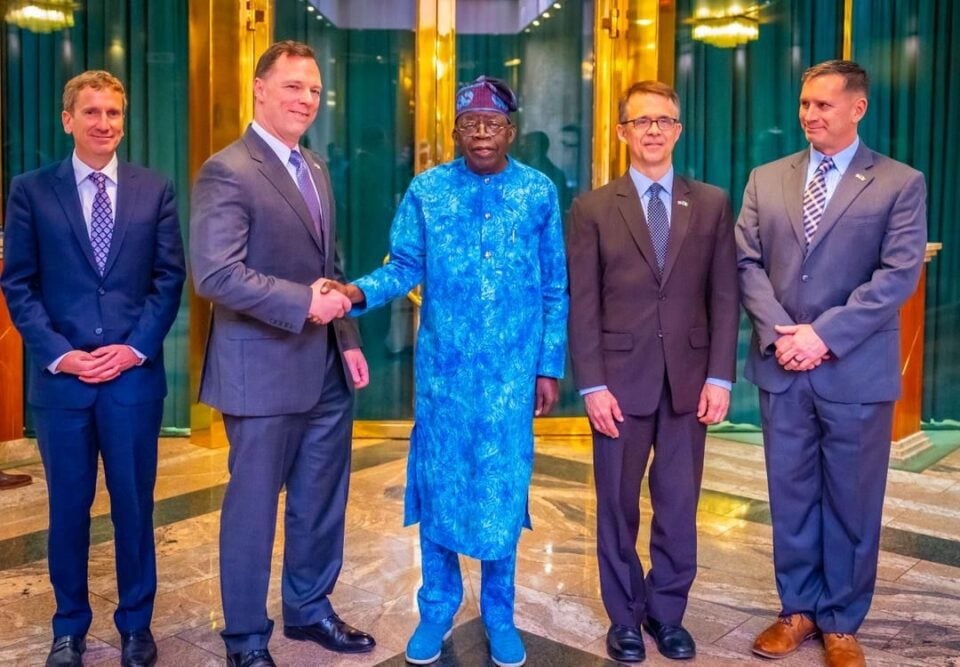
President Bola Ahmed Tinubu has received a high-level delegation from the United States led by the Commander of the United States Africa Command (AFRICOM), General Dagvin R. Anderson, at the State House, Abuja.
The visit was confirmed in a statement issued Sunday by the Special Assistant to the President on Social Media, Dada Olusegun. The President hosted the delegation alongside National Security Adviser Nuhu Ribadu and Nigeria’s service chiefs.
The U.S. delegation also included members of General Anderson’s team and the Chargé d’Affaires of the U.S. Embassy in Nigeria, Keith Heffern. The meeting focused on strengthening military cooperation and security collaboration between both countries.
The visit comes amid growing security cooperation between Nigeria and the United States, particularly in counterterrorism operations across West Africa. Recent reports indicate that the United States deployed a small team of military personnel to Nigeria, marking the first confirmed official U.S. military presence on the ground in the country following earlier air operations.
According to U.S. officials, the deployment is aimed at supporting Nigeria’s counterterrorism operations by providing specialised capabilities, intelligence, and operational assistance against extremist groups operating in the region.
The deployment followed U.S. airstrikes carried out on December 25, 2025, targeting Islamic State-linked militant positions in northwestern Nigeria. The strikes were conducted in coordination with Nigerian authorities as part of joint security efforts against terrorist networks.
Prior to these operations, U.S. surveillance and intelligence support had been ongoing as part of broader regional security collaboration aimed at addressing escalating threats posed by extremist groups such as Boko Haram and Islamic State West Africa Province (ISWAP).
Speaking on the growing partnership, General Anderson noted that increased collaboration between both countries led to the deployment of a small U.S. team bringing specialised capabilities to complement Nigeria’s long-standing counterterrorism efforts.
Security analysts say the evolving partnership reflects broader efforts by Nigeria and its international allies to address worsening insecurity in parts of the country and across the Sahel region.
